
Kane County Court Record serves as the official judicial authority for legal matters filed within Kane County, Illinois. The court manages case hearings, filings, and rulings across civil, criminal, family, and traffic law. It operates under the county judiciary structure and follows statewide Illinois courts procedures. Residents rely on this court for accurate case handling and lawful resolutions.
Kane County Court functions within the 16th Judicial Circuit of Illinois and applies state laws at the local level. The court maintains official records, schedules, and judicial decisions through its clerk offices. These records help confirm case status, party details, and court outcomes. This role makes the court a trusted legal institution for Kane County matters.
How to Search Kane County Court Records & Cases
Searching Kane County court records online is straightforward if you follow the official process. Residents, attorneys, and researchers can use the county’s court database to perform a case lookup, view docket entries, and monitor public access records.
Online Search Overview
Kane County provides an official online portal for court records. This system allows users to access case information without visiting the courthouse, offering online access to civil, criminal, probate, traffic, and family law cases.
Official portal: https://kanecoportal.co.kane.il.us/portal
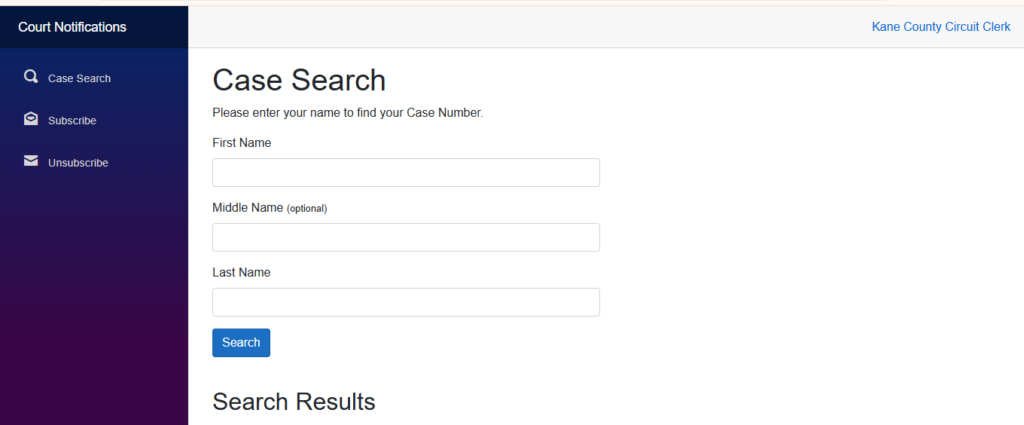
Users can search by case number or party name. Some records, such as juvenile or confidential cases, have restricted access for privacy reasons.
Search by Case Number
The quickest way to locate a specific case is through the case number:
- Open the official search portal: https://kanecoportal.co.kane.il.us/portal
- Select “Search by Case Number.”
- Enter the full case number exactly as assigned (e.g., 2025CM123).
- Click Search.
The results display the case docket, parties involved, and upcoming court dates. Searching by case number reduces irrelevant results and ensures accuracy in case lookup.
Search by Party Name
If the case number is unknown, users can search by party name:
- Choose “Search by Party Name” on the portal.
- Enter the last name first, followed by the first name.
- Optional: filter by case type, year, or division to narrow results.
- Click Search and review the list to identify the correct case.
Name searches may return multiple cases, particularly for common names. Users should verify details such as filing date and case type to find the correct record.
Search Limitations
While the online system offers convenience, there are some limitations:
- Juvenile and sealed cases are not publicly available.
- Older cases may not be digitized and may require an in-person request.
- Certain case documents are only viewable in the courthouse; some may require fees.
- The system provides basic docket information but may not include all filings or exhibits.
By understanding these limitations, users can efficiently use the Kane County court database for accurate case lookup and public access.
Kane County Case Records vs Case Search
Many people confuse Kane County case records with the case search portal. Understanding the distinction ensures accurate use of official resources.
Case records are the official court documents filed for a case, including motions, judgments, orders, and filings. These provide a complete record of the case history in the docket system.
In contrast, a case search is a tool that provides a summary of a case, including case status, parties, and scheduled hearings. It is ideal for quick reference but does not include the full set of official documents.
Key differences:
| Feature | Kane County Case Records | Case Search Tool |
|---|---|---|
| Complete filed documents | Yes | No, summary only |
| Shows case status | Yes | Yes |
| Access method | Online or in-person | Online portal |
| Best use | Legal research, verification | Quick case reference |
What Are Kane County Court Records?
Kane County Court Records are official documents that provide detailed information about legal cases filed and processed in Kane County. They serve as an official account of judicial proceedings, including the outcomes and history of each case.
These records are a type of legal document maintained by the county court system to ensure transparency and accountability. They include a variety of information, such as civil and criminal case filings, motions, judgments, and sentencing details. Anyone interested in a case’s background—such as lawyers, researchers, or members of the public—can use these records to verify facts and review case history.
Types of Kane County Court Records
Kane County Court Records cover multiple categories, reflecting the range of cases handled by the court. Key types include:
- Criminal Records: Document arrests, charges, court proceedings, and verdicts.
- Civil Records: Include lawsuits, disputes, and resolutions between parties.
- Probate Records: Detail wills, estate settlements, and guardianship matters.
- Traffic and Municipal Records: Track traffic violations and local ordinance cases.
These judicial records are often used by attorneys to prepare for cases or by individuals conducting background research. They help maintain an official, chronological account of legal activities within the county.
Kane County Court in the Illinois Judicial System
The Kane County Court in Illinois is a trial-level court that handles a wide range of cases within its jurisdiction. It functions as an essential part of the state judiciary, processing both civil and criminal matters for residents and businesses in Kane County.
As part of the Illinois courts system, the Kane County Court Illinois serves as the first point of entry for most legal disputes. It interprets and applies state laws, ensures due process, and manages the formal documentation of cases through judicial records. Its decisions may influence higher court rulings, as appeals from this court move to the Illinois Appellate Court.
Structure and Jurisdiction
The Kane County Court operates under Illinois state law, with multiple divisions to address different case types:
- Civil Division: Handles disputes between individuals or organizations, including contracts, personal injury, and property matters.
- Criminal Division: Oversees cases involving felony and misdemeanor charges.
- Probate Division: Manages estate settlements, wills, and guardianships.
- Traffic and Municipal Division: Resolves local ordinance violations and traffic cases.
The court system ensures that each case follows a clear legal process, from filing to judgment, with all proceedings recorded in official Kane County Court Records. This maintains transparency and accountability within the local judicial system.
Role Within the Illinois Judicial System
Kane County Court Illinois operates under the supervision of the Illinois Supreme Court and coordinates with other state judiciary entities. It provides residents access to justice while supporting statewide legal standards. Lawyers, businesses, and citizens rely on this court for timely resolution of disputes and accurate judicial documentation.
Types of Cases Handled by Kane County Court
Kane County Court manages a broad range of legal matters, ensuring that residents have access to justice for both civil and criminal disputes. Each case type is handled in a dedicated division, allowing judges and staff to provide specialized attention and maintain proper legal procedures.
Civil Cases
Civil cases involve disputes between individuals, businesses, or organizations. Common examples include:
- Contract disagreements
- Property disputes
- Personal injury claims
- Landlord-tenant conflicts
These cases aim to resolve conflicts through monetary compensation, court orders, or other remedies rather than criminal punishment.
Criminal Cases
Criminal cases cover offenses against the law, from minor infractions to serious felonies. The court ensures that defendants receive a fair trial and that victims’ rights are protected. Typical criminal matters include:
- Theft and burglary
- Assault and battery
- Drug-related offenses
- Domestic violence
Judges in criminal cases follow strict procedures to determine guilt, set sentences, and enforce penalties according to Illinois law.
Family Law
Family law cases address personal and domestic matters that affect relationships and children. This division handles issues such as:
- Divorce and legal separation
- Child custody and visitation
- Child and spousal support
- Adoption proceedings
These cases often require careful attention to both legal standards and the well-being of family members involved.
Probate Cases
Probate cases involve managing estates, wills, and guardianships. The court ensures that property is distributed according to the deceased’s wishes or legal guidelines. Key matters include:
- Validating wills
- Administering estates
- Appointing guardians for minors or incapacitated adults
Traffic Violations
The court also addresses traffic-related matters, including citations, license suspensions, and local ordinance violations. These cases are typically resolved quickly but are important for public safety and law enforcement.
Juvenile Matters
Juvenile cases involve minors who may be accused of delinquent acts or need protection through family court interventions. The goal is often rehabilitation rather than punishment. Cases include:
- Juvenile delinquency
- Child protection and abuse cases
- Status offenses like truancy
By handling this wide spectrum of cases, Kane County Court provides residents with a comprehensive legal system capable of addressing civil, criminal, family, probate, traffic, and juvenile matters efficiently and fairly. Each division is designed to manage its specific case type while maintaining consistency and transparency across the county’s judicial processes.
Role of the Kane County Clerk in Court Records
The Kane County Clerk plays a central role in maintaining and managing court records. Acting as the official custodian, the clerk ensures that all documents are properly filed, organized, and accessible through the county’s filing system.
The clerk’s office oversees court administration, including processing civil, criminal, probate, and traffic cases. Responsibilities include:
- Recording all case filings accurately and securely
- Maintaining official court records and dockets
- Providing copies of documents to attorneys, researchers, and the public
- Managing online databases and record management systems for easier access
Through these duties, the Kane County Clerk upholds transparency and accountability in the judicial process. By ensuring that every document is properly cataloged and retrievable, the clerk supports both legal professionals and residents seeking reliable information about court proceedings.
Fees, Access Rules & Record Restrictions
Accessing Kane County court records is generally open to the public, but certain fees, access rules, and restrictions apply to ensure privacy and compliance with state law. Understanding these guidelines helps users navigate the system confidently while respecting legal boundaries.
Fees
Some court documents and records may require payment for copies or certified certifications. Typical fees include:
- Copying fees for paper documents
- Certified copies for official or legal use
- Small service charges for electronic downloads in certain cases
Payments are usually made at the clerk’s office or through the official online portal when requesting documents electronically.
Access Rules
Kane County courts maintain clear visitor access rules to balance public transparency with courtroom security. Key points include:
- Public access is allowed to most civil, criminal, probate, and traffic cases
- Courtrooms may limit seating during hearings
- Electronic devices, photography, and recording are generally restricted inside courtrooms
- Public counters and online portals provide information without entering courtrooms
Record Restrictions
Certain court documents remain confidential to protect sensitive information. These access limits apply to:
- Juvenile records, including delinquency or child protection cases
- Sealed cases and sensitive family law matters
- Portions of case files that involve personal identifying information or security concerns
Restricted documents cannot be viewed or copied without a court order or special authorization. These safeguards ensure compliance with state law while maintaining public trust in the judicial system.
Kane County Court Locations & Courthouse Access
Kane County operates several courthouses and judicial facilities that serve residents, lawyers, and the public. Each location supports specific court functions and provides structured visitor access for hearings, filings, and records.
Main Court Locations & Addresses
Judicial & Civil Court Locations:
- Kane County Courthouse – This is the primary courthouse handling civil matters, probate, small claims, and some general court functions.
Address: 100 S. 3rd Street, Geneva, IL 60134 - Kane County Judicial Center – Major facility for criminal, traffic, family law, and general court administration.
Address: 37W777 State Route 38, St. Charles, IL 60175 - Juvenile Matters / Youth Cases
Kane County Juvenile Justice Center – Handles cases involving minors and juvenile court dockets.
Address: 37W655 Route 38, St. Charles, IL 60175
Branch & Satellite Court Locations:
- Kane County Branch Court – Handles traffic, ordinance violations, misdemeanor matters, and services closer to central St. Charles.
Address: 530 S. Randall Road, St. Charles, IL 60174 - Circuit Court of Kane County – Aurora Branch – Local branch for Aurora and surrounding areas.
Address: 1200 E. Indian Trail Road, Aurora, IL 60505 - Elgin Branch Court – Serves Elgin and nearby communities with circuit court services.
Address: 150 Dexter Court, Elgin, IL 60120
Accessibility
Kane County courts are designed to be accessible for the public during regular business hours (typically Monday–Friday, morning through late afternoon). Facilities often include:
- Visitor parking close to building entrances.
- Wheelchair ramps and elevators for mobility access.
- Clear signage to guide visitors to the correct courtrooms and clerk offices.
- Public service desks for general help and questions.
Security screening at public entrances is standard and all visitors should anticipate metal detector checks before entering courtrooms
Public Access Rules
While many court areas and records are open to the public, some limitations apply:
- Juvenile court proceedings and sealed cases: Confidential and not available publicly.
- Courtroom conduct: Electronic devices, recording, and photography are restricted.
- Seating in courtrooms may be limited during ongoing hearings.
- Record copies: Full documents may require an in‑person request or small fee at the clerk’s counter.
History of Kane County Court
Kane County Court has a rich history that reflects the growth of the county and its judicial system. Established shortly after Kane County itself was formed in 1836, the court was created to handle legal disputes, maintain order, and provide a formal structure for county governance.
Establishment of the Court
The first sessions of Kane County Court were held in modest facilities, addressing both civil and criminal matters. Early judges and clerks laid the foundation for a structured court history, ensuring that residents had access to lawful dispute resolution and a fair judicial process.
Evolution of the Judicial System
Over the years, Kane County Court expanded to meet the needs of a growing population. The court system evolved to include specialized divisions, such as civil, criminal, probate, family law, and traffic courts. Modern technology and record management systems have further improved efficiency, allowing for online case lookup, public access to dockets, and better judicial development.
Role in County Governance
Beyond adjudicating cases, Kane County Court has played a key role in supporting county governance. Decisions from the court affect local policies, property disputes, estate settlements, and law enforcement procedures. By maintaining consistent legal oversight, the court contributes to the stability and functionality of county government while upholding public trust.
Frequently Asked Questions
This FAQ section addresses common questions about Kane County Court and helps users access accurate court information quickly. Answers cover official tools, common issues, and practical steps for finding and printing court records.
Are Kane County court records public?
Yes, most Kane County court records are considered public access documents. This includes civil, criminal, probate, and traffic cases. Public access ensures transparency in the judicial process, allowing residents, attorneys, and researchers to review case information. However, certain records—such as juvenile cases, sealed cases, or sensitive family law matters—are restricted to protect privacy.
How do I search Kane County court cases?
You can search Kane County court cases through the official online court database. The most common search methods include:
- By Case Number: Enter the exact case number for precise results.
- By Party Name: Enter the first and last name of an individual or business involved in the case.
Visit the official search portal here: https://kanecoportal.co.kane.il.us/portal
For older records not available online, you may need to contact or visit the Kane County Circuit Clerk’s office in person.
How far back do records go?
Kane County court records date back to the county’s establishment in 1836. Modern records are digitally maintained for easier online access, while older records may be available in archived formats at the clerk’s office. Some historical records may require a formal request to access due to preservation and confidentiality rules
Can I access records online?
Yes, many Kane County court records are accessible via the court’s online case lookup system. Users can:
- Review dockets and case activity
- Check scheduled court dates
- Obtain basic case information for civil, criminal, probate, and traffic cases